Expert FAQ: Bridging the Gap Between Design and Durability
Welcome to the NeopreneX Technical Support Center. Whether you’re developing high-fashion bags, electronics protection, or sports gear, get the professional clarity you need on material science, high-end stitching, and global OEM standards.
Material Science & Textile Engineering
Explore the technical properties of SBR, SCR, and CR cores, along with specialized lamination options tailored for high-performance industrial and luxury fashion applications.
What is the core difference between SBR and CR neoprene?
SBR offers excellent cost-performance for fashion bags, while CR provides superior chemical resistance and resilience for high-performance protective or water sports gear.
Why is the closed-cell structure critical for electronics protection?
The closed-cell structure is filled with micro-air bubbles, providing exceptional shock absorption and a waterproof barrier, effectively absorbing pressures
How to choose between Polyester and Nylon lamination?
Polyester supports high-definition sublimation printing for intricate bag designs, while Nylon offers a softer feel and higher abrasion resistance for products in skin contact.
How does high-density SBR core prevent bag sagging?
High-density SBR possesses stronger molecular memory, maintaining an architectural silhouette even under heavy loads.
What is the typical thickness tolerance for neoprene?
As a flexible material, neoprene thickness is controlled within reasonable industry-standard tolerances during production to ensure structural integrity.
Can neoprene be made odorless?
The pungent odor often associated with neoprene typically stems from toluene-based solvent glues used in traditional lamination. We have fully transitioned to eco-friendly lamination processes, completely eliminating toluene solvents. By utilizing water-based or solvent-free adhesives, our finished products are free from sharp chemical odors, meeting the stringent odor and environmental standards required for high-end fashion and medical-grade applications.
What is "rebound efficiency" and why does it matter?
Rebound efficiency measures the ability to return to the original shape after compression; high efficiency ensures products like laptop sleeves don’t lose cushioning over time.
Will the fabric delaminate after lamination?
Using high-performance adhesives and constant-temperature heat-pressing, we ensure the fabric and core remain permanently bonded without delamination.
How to select materials suitable for medical supports?
Medical supports typically utilize perforated materials for breathability, paired with skin-friendly fabrics.
What are the sources of sustainable neoprene?
Our sustainable solutions focus on closed-loop recycling. We utilize eco-friendly textiles made from recycled plastic bottles (RPET) for lamination. Additionally, beyond our toluene-free adhesive process, we prioritize neoprene cores infused with Eco Carbon Black—derived from recycled scrap tires—effectively reducing carbon emissions by over 20%.
Advanced Craftsmanship & Manufacturing Techniques
From high-precision laser perforation to high-end stitching and vibrant sublimation printing, discover how we transform raw neoprene into premium finished goods with structural integrity.
What is 4-needle 6-thread Flatlock stitching?
It is a highly flat and strong stitching method that eliminates bulk at the seams, providing a skin-like feel.
What are the advantages of laser perforation?
Laser cutting achieves high edge precision while adding breathability and visual texture without compromising structural integrity.
How to prevent sublimation patterns from fading?
By precisely controlling heat-press temperature and pressure, we ensure the ink sublimates into the fibers for long-lasting color.
Why do logos on bags crack when stretched?
This is due to a mismatch between print paste elongation and fabric stretch. We use high-elasticity compatible inks to solve this pain point.
Does the embossing process change material thickness?
Embossing uses physical molds to press textures, altering visual depth locally without damaging the overall core thickness.
Why do zippers on crossbody bags sometimes look wavy?
This is caused by uneven tension between elastic fabric and non-elastic zipper tape. We balance this stress through precision engineering.
How to reinforce the handles of a tote bag?
We use Zig-Zag reinforcement stitching at stress points and internal support webbing to enhance load-bearing capacity.
Are neoprene bags washable?
Yes, neoprene is highly water-resistant. We recommend cold hand washing to protect metal hardware and print colors.
What is the binding process and what is its function?
Binding involves wrapping webbings around cut edges to hide seams for aesthetics and enhance edge durability.
How do you handle the edges of neoprene products?
We offer various techniques including raw-cut, overlock, and premium binding to meet different design tiers.
Why do black spots appear on heat transfer logos on Black Lycra?
This is “Dye Migration.” Heat-activated dyes in black fabric can bleed into the logo layers over 3–12 weeks, especially during sea freight or warehouse storage. To prevent this “silent killer,” NeopreneX follows a strict SOP:
Mandatory Anti-sublimation Barrier: A specialized blocking layer integrated into the logo base.
48-hour High-Temp Simulation: We test every high-risk fabric batch before mass production to ensure long-term stability.
Technical Insight: > We built this protocol after a major lesson in 2008 involving a German laptop sleeve project. Read the full Technical Case Study here
Service, Logistics & Global OEM Collaboration
Get professional clarity on our manufacturing standards, MOQ requirements, global lead times, and how we partner with brands to scale production from prototype to market.
We offer 1 square meter of FREE sample (from existing stock colors) for quality and hand-feel verification.
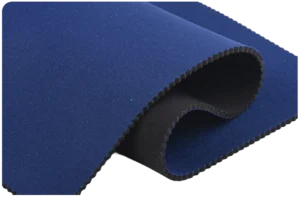
MOQ depends on material specs and process complexity. Typically, standard colors and thicknesses offer more flexibility.
For standard designs, initial samples are typically completed and delivered within 5-7 working days.
Generally completed within 15~20 days after sample approval, depending on order size and production schedule.
We strictly follow ISO manufacturing standards for production management to ensure quality consistency for every component.
Yes, we offer full-process services from custom branding labels and logo printing to personalized packaging.
We have established a standardized audit process from raw material entry to finished product inspection, implementing full-process monitoring.
We partner with multiple international logistics firms, supporting flexible delivery options via sea, air, and express.
No tooling fees apply if you choose from our existing library. We maintain an inventory of dozens of standard patterns (see preview below) that are free to use.
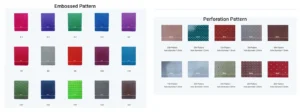
👉 [View Full Pattern & Perforation Gallery →]
Tooling charges only apply to proprietary, non-standard shapes. These costs will be transparently disclosed during quoting.
Please provide detailed design drafts, specifications, and expected quantities; our expert team will respond within 24 hours.
We prioritize intellectual property protection and can sign NDAs to ensure client designs remain confidential.