
How to Choose Neoprene Fabric for OEM and Wholesale
By Harry  | ISO Lead Auditor| June 10, 2026
If you are sourcing neoprene for OEM or wholesale, you have probably noticed that the same “neoprene” can look, feel, and perform completely differently depending on the supplier.
This guide walks you through the seven decisions you must make before placing a bulk order: thickness, density, surface fabric, lamination, color & roll size, MOQ & lead time, and quality testing. We also include a specification sheet template that you can copy and send directly to suppliers.
By the end, you will know exactly what to ask – and what to avoid.
What OEM Buyers Should Care About First
Define the final product
Before comparing samples, write down:
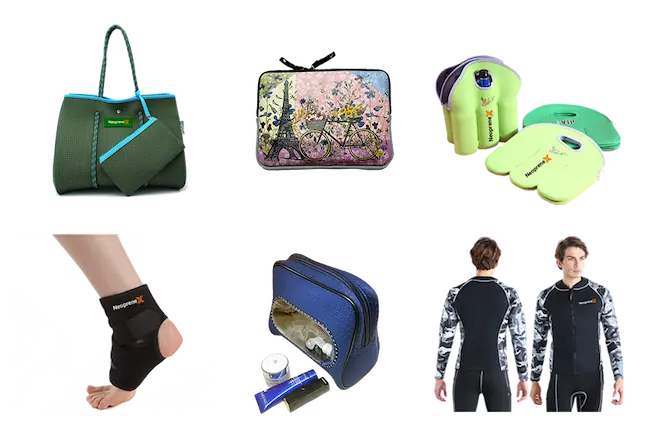
- What will the neoprene be used for? (laptop sleeve? knee brace? wetsuit? industrial pad?)
- What environment? (water? heat? repetitive motion?)
- What production method? (sewing? die‑cutting? gluing? heat pressing?)
A material that works for a bag will likely fail for a wetsuit. Always start with the application.
Identify your production method
Your manufacturing process limits which neoprene you can use:
| Production method | Preferred thickness | Special considerations |
|---|---|---|
| Sewing (standard) | ≤3mm | Use needle size 16–18; 4mm+ may break needles |
| Sewing (overlock) | Up to 5mm | Possible, but test first |
| Die-cutting | Any | Need sharper dies for ≥4mm |
| Gluing / bonding | ≤4mm | Thicker requires more aggressive adhesive |
| Heat pressing | ≤3mm | Thicker risks surface burn |
Thickness and Density
Thickness options – from 2mm to 5mm+
Use this quick guide:
- 2mm– Very flexible, low protection. Best for: light gloves, liners, thin sleeves.
- 3mm– The workhorse. Good balance of flexibility and protection. Best for: laptop sleeves, braces, camera wraps.
- 4mm– Firm, good cushioning. Best for: knee pads, tool rolls, cooler bags.
5mm+ – High protection, low flexibility. Best for: cold‑water wetsuits, industrial mats
For a deeper dive, see our Neoprene Thickness Guide.
Why density matters
Two 3mm sheets can feel completely different. Density is measured by how much the foam compresses under a given weight.
- Low density– Soft, comfortable, but wears out faster. Good for consumer goods.
- High density– Firm, durable, better for load‑bearing products.
OEM tip: If your product feels too flimsy at 3mm, increase density – not thickness. A high‑density 3mm often outperforms a low‑density 4mm.
Surface Fabric and Lamination
Common surface options
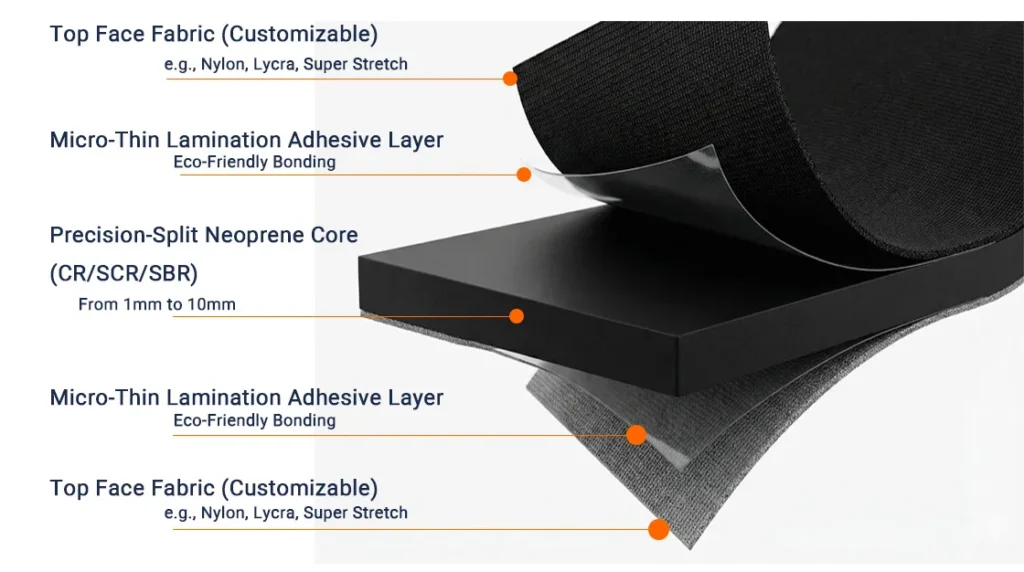
Neoprene is almost always laminated with a textile on one or both sides:
| Fabric | Feel | Durability | Best for |
|---|---|---|---|
| Nylon jersey | Soft, smooth | Medium | Skin-contact (braces, wetsuits) |
| Polyester | Slightly rough | High | Bags, cases (abrasion resistance) |
| Nylon oxford | Very tough | Very high | Heavy-duty bags, industrial |
| Un-laminated (raw foam) | Grippy | Low | Anti-slip pads, interior layers |
Match the surface to your production
- For sublimation printing: Use polyester surface (nylon does not take dye well).
- For screen printing: Most surfaces work, but test adhesion.
- For sewing: Nylon jersey is easiest; heavy oxford may require stronger needles.
See all standard and custom neoprene fabric options. Browse our full range of neoprene materials Explore our comprehensive selection of raw sheets available for custom lamination, printing, and CNC/die-cutting, covering thicknesses from 1.5mm to 15mm.
Product Structure – Plain Sheets vs. Laminated Materials
Most neoprene is sold as laminated sheets (foam + fabric on one or both sides). But some applications need:
- Plain neoprene (no lamination)– Used as internal padding or anti‑slip layers. Less common for finished goods.
- Double‑side lamination– Fabric on both sides. Standard for braces, bags, and most consumer products.
- Single‑side lamination– Fabric outside, raw foam inside. Used when the inside does not need to be pretty.
OEM note: Always tell your supplier whether the final product will be sewn, glued, or die‑cut. Each process may require a different lamination strength.
Color, Width, and Roll Size – Details That Cost You Money
Color consistency
Neoprene can be colored, but batch‑to‑batch variation is common.
- For small runs (<500 sheets), color matching is usually fine.
- For repeat orders, ask for color swatchesfrom each batch before shipping.
Width and roll length – the hidden cost driver
Most neoprene rolls come in widths of 1.0m, 1.3m.
- If your cutting layout does not match the roll width, you can lose 10–20% of material to waste.
- Always ask: “What is the usable width after trimming?” (Some suppliers quote full width, but edges are unusable.)
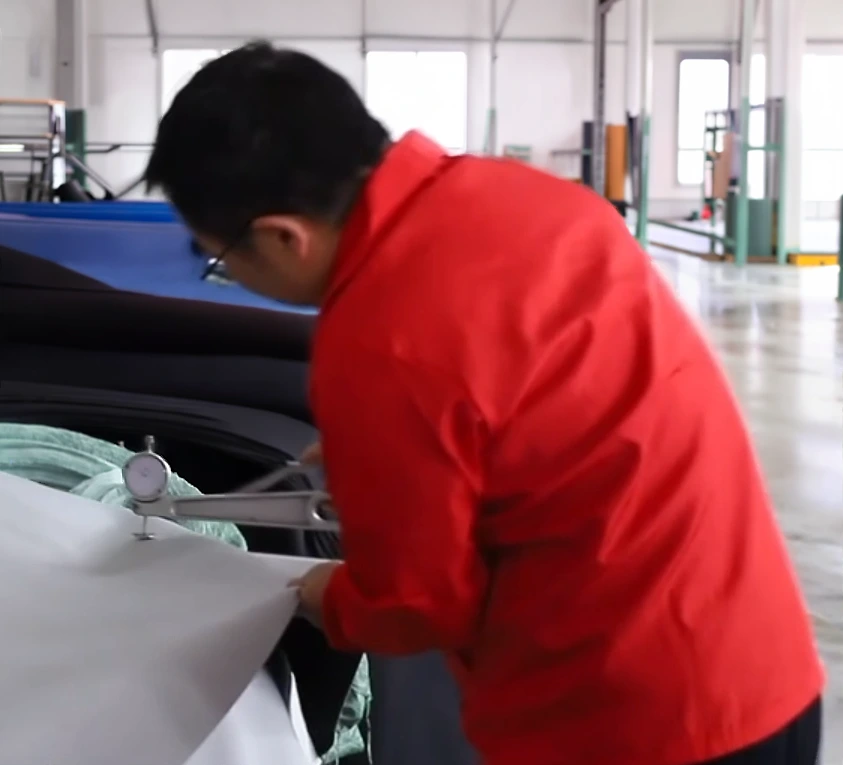
Our standard neoprene fabric width is 1.3 m, with a usable width of 1.27 m. We also offer extra-wide material for customers to choose from, available up to 1.5 m.
MOQ, Lead Time, and Sampling – The Commercial Reality
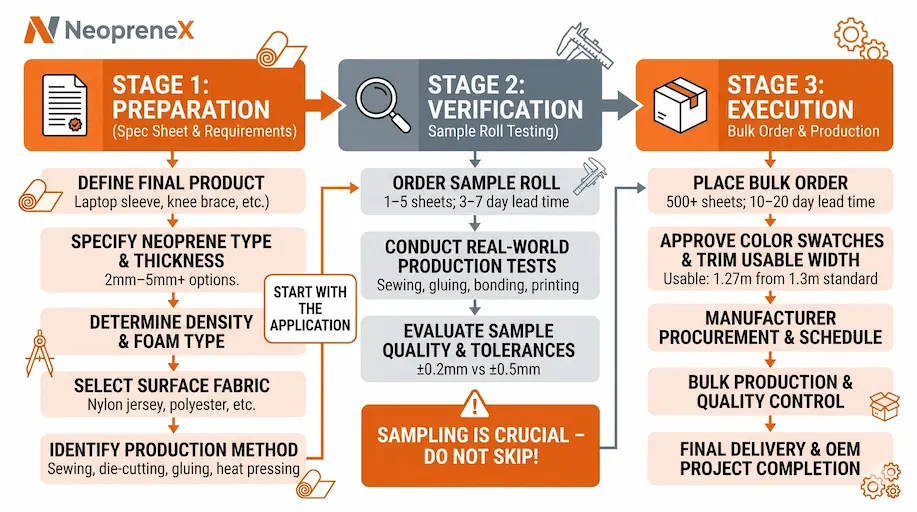
MOQ planning
Typical MOQs for OEM neoprene:
| Order type | MOQ (sheets or rolls) |
|---|---|
| Sample roll | 1–5 sheets (usually paid) |
| Small trial | 20–50 sheets |
| Standard wholesale | 50+ sheets |
| Custom color / non-standard thickness | 50+ sheets |
Lead time expectations
- Sample roll: 3–7 days after order confirmation
- Trial quantity (50–100 sheets): 10–15 days
- Bulk order (500+ sheets): 10–20 days
- Repeat orders: Often faster (7–10 days) if material is in stock
OEM tip: Always ask: “Is your lead time from material in stock, or from raw material procurement?” Many suppliers quote the former but deliver the latter.
Sampling – do not skip this
- A sample roll is cheap compared to a failed mass production. Test the sample in your actual production workflow (sewing, gluing, printing) before approving the bulk order
Quality and Testing – What to Check
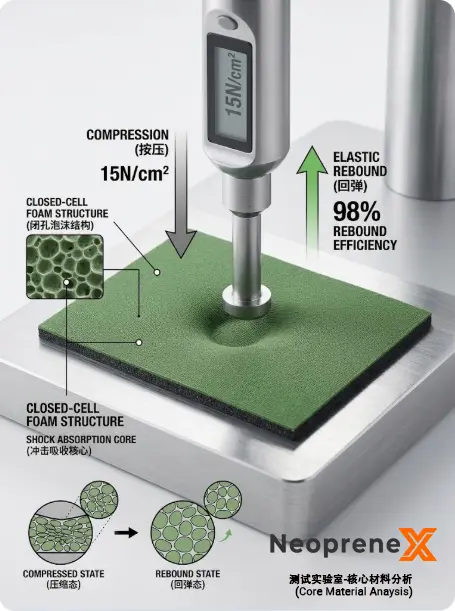
At minimum, ask your supplier for:
| Test | Why it matters |
|---|---|
| Thickness tolerance (±0.2mm vs ±0.5mm) | Affects fit and consistency |
| Density / hardness (Asker C or Shore OO) | Affects feel and durability |
| Stretch recovery | How long the material stays tight (for braces) |
| Compression set | Will padding flatten over time? |
| Bond strength | Does lamination separate after sewing? |
- For regulated products (medical, children’s items, food contact): Ask for relevant certificates (ISO 10993, REACH, ROHS, FDA)
How to Communicate Your Requirements – Spec Sheet Template
The fastest way to get a correct quote is to send a specification sheet. Copy and fill this template:
| PRODUCT SPECIFICATION – NEOPRENE | |
|---|---|
| 1. Final product | [e.g., laptop sleeve for 15” MacBook] |
| 2. Thickness | [2mm / 3mm / 4mm / 5mm] + tolerance: [±0.2mm] |
| 3. Density | [soft / medium / firm] |
| 4. Surface fabric (outside) | [nylon jersey / polyester / oxford / none] |
| 5. Surface fabric (inside) | [same or different] |
| 6. Color | [Pantone code or "black"] |
| 7. Width | [1.3m / 1.5m / other] |
| 8. Quantity | [sheets or rolls] |
| 9. Production method | [sewing / die-cutting / gluing / heat pressing] |
| 10. Special requirements | [sublimation printing / flame retardant / latex-free] |
Example of a strong inquiry (weak vs. strong):
- ❌ Weak: “Do you have neoprene?”
- ✅ Strong: “We need 3mm laminated neoprene for custom laptop sleeves, black, 1.3m width, ±0.2mm tolerance, suitable for sewing and heat transfer branding. MOQ 500 sheets. Please quote.”
Common Mistakes to Avoid
| Mistake | Why it backfires | Better approach |
|---|---|---|
| Focusing only on price | Cheap material may tear, sew poorly, or fail bonding | Compare total cost (material + waste + rework) |
| Skipping sample testing | Problems discovered only during mass production | Always run a sample through your full workflow |
| Ignoring thickness tolerance | Inconsistent fit (loose or too tight) | Put tolerance in writing on your PO |
| Not asking about lamination bond strength | Fabric separates after washing or stretching | Request bond strength data (peel test) |
FAQ
There is no single answer. 3mm is the most common starting point for consumer goods like bags and braces. For industrial or high‑protection applications, go thicker.
Yes. Suppliers can customize thickness, color, surface fabric, roll width, and lamination structure – usually with a minimum quantity.
Ask about: thickness tolerance, surface fabric options, MOQ, lead time, sample availability, color matching across batches, and compatibility with your production method.
Yes. Sample testing is the single most important step in OEM sourcing. It confirms sewing, bonding, appearance, and final performance before you commit to a large order.
Do not compare price per sheet alone. Compare: thickness tolerance, density, fabric quality, sample policy, lead time, and payment terms. A slightly higher price with tighter tolerance may save you money in rework
Conclusion
hoosing neoprene for OEM and wholesale is a process of matching the material to your product, your production method, and your customer’s expectations. When you define those requirements clearly from the start, you reduce mistakes, save sampling time, and improve mass production results.
Your next step:
- Fill out the spec sheet template above.
- Send it to Neoprenexfor a recommendation and quote.
- Order a sample roll and test it in your actual production line.
Need Help Choosing the Right Neoprene Fabric?
Contact Neoprenex – send your spec sheet or product sketch. We will reply with thickness, surface fabric, color, MOQ, and delivery options tailored to your project.